Sustainable Palm (kernel) oil

Henkel wants to drive progress toward sustainable palm oil and palm kernel oil – and make a positive impact on both the environment and the people affected.
Henkel is actively driving progress toward fully sustainable palm and palm kernel oil, ensuring our actions benefit both the planet and the people and communities connected to our supply chain. Henkel sources ingredients based on palm and palm kernel oil for many of its products. Palm kernel oil, for example, is an important basis for industrially produced surfactants. For this reason, Henkel is committed to ensuring that the ingredients for its products are made from sustainable palm oil and palm kernel oil.

Palm (kernel) oil is one of the most widely used vegetable oils in the world. It is used as an 
ingredient in foods, as biofuel and as feedstock for raw materials for cosmetics and cleaning 
products due to its versatility, stability and other physio-chemical properties. Its popularity is 
also caused by the high production yield and, along with that, low production costs. Oil palm 
trees produce around four to ten times more oil per hectare than other crops like soy, 
sunflower, or rapeseed. The production of palm (kernel) oil is a significant contributor to 
national economies, especially in Indonesia and Malaysia, and provides livelihoods for millions 
of smallholder farmers and workers in producing countries. However, these positive effects 
can only be levered if palm (kernel) oil is sourced sustainably.

 
Contradicting, if done unsustainably, palm (kernel) oil production has significant negative 
environmental and social impacts. Large areas of tropical rainforest in Indonesia and Malaysia – producing ~85% of global palm (kernel) oil – have been cleared for plantations. Illegal 
burning practices also contribute to transboundary haze pollution, affecting human health 
across Southeast Asia.  Clearing forests, especially peatlands, releases huge amounts of carbon 
dioxide and methane. Therefore, oil palm cultivation has been a major contributor to Southeast 
Asia’s greenhouse gas emissions. The ongoing deforestation also destroys critical habitats for 
endangered species like orangutans, tigers, elephants, and rhinos. Monoculture plantations 
drastically reduce biodiversity compared to natural forests. Soil health, water systems, and 
pollinator populations are negatively affected. Apart from the negative environmental impacts 
of oil palm farming, reports of exploitative labor conditions, child labor, and land conflicts with 
Indigenous peoples are linked to the palm (kernel) oil industry.


Palm (kernel) oil remains a debated raw material: while its cultivation can lead to deforestation, 
emissions, biodiversity loss, and social challenges, it is also highly efficient, versatile, and 
economically important. The main debate therefore is not whether palm (kernel) oil is 
inherently causing negative impacts, but whether it can be produced more sustainably and 
ethically compared to its alternatives, such as coconut oil or shea butter. Certification schemes 
like RSPO (Roundtable on Sustainable Palm Oil) aim to improve practices, reduce 
deforestation, and ensure fair labor. Some companies and NGOs push for deforestation-free supply chains. With better management, palm (kernel) oil could be more sustainable than alternatives, if demand continues to rise.

Relevance for Henkel

Henkel recognizes its responsibilities regarding the purchase and use of ingredients based on 
renewable raw materials, including palm (kernel) oil. Palm (kernel) oil and derivatives thereof 
are used as ingredients for a variety of products, for example, as an important basis for 
industrially produced surfactants. The derivatives used at Henkel are at the end of a long and 
often highly complex supply chain. In total, Henkel uses less than 0.2 percent of the palm oil 
and palm kernel oil produced worldwide (status 2024). 

Henkel started its journey towards the responsible sourcing of palm (kernel) oil two decades 
ago. Back in 2003, Henkel attended the first meeting of the Roundtable on Sustainable Palm 
Oil (RSPO) and started engagement with World Wildlife Fund (WWF) and other stakeholders 
to prevent the destruction of rain forests in Indonesia. When the first volumes of RSPO
certified palm oils were available in 2008, Henkel became a member of the RSPO, an important 
step toward sustainable palm (kernel) oil sourcing and started to purchase certified palm oil, 
palm kernel oil and their derivatives. In 2011, the company targets already included a 
commitment to source RSPO certified palm (kernel) oil. In 2012, Henkel began a collaboration 
with the development organization Solidaridad to promote sustainable practices among 
smallholders. Together with other companies like Rewe and Unilever and the WWF, Henkel 
co-founded the “Forum Nachhaltiges Palmöl” (Forum for Sustainable Palm Oil, FONAP) in 
2013. In 2014, the palm (kernel) oil target was revised to include also traceability of palm 
(kernel) oil. A first pilot project on the traceability of palm (kernel) oil was carried out in 2015. 
Henkel became a founding member of Action for Sustainable Derivatives (ASD) in 2019. 
Together with Orbital Insight, Henkel launched a pilot project in 2020 to use satellite imaging 
for palm (kernel) oil traceability. In 2021, Henkel set new targets on responsible palm (kernel) 
oil, committing to 100 percent responsibly sourced and traceable palm and palm kernel oil.

 
Henkel Palm (Kernel) Oil Commitments 

Henkel is actively driving progress toward fully sustainable palm and palm kernel oil, ensuring 
our actions benefit both the planet and the people and communities connected to our supply 
chain. For this reason, Henkel is committed to ensuring that the ingredients for its products 
are made from sustainable palm oil and palm kernel oil.  

Building on the long-lasting engagement to ensure responsible sourcing of palm (kernel) oil, 
Henkel stays committed to the following actions that address the key priorities for successfully 
transforming the palm oil industry:  

  • Cover 100 percent of our demand with palm and palm kernel oil responsibly sourced 
    and certified 
    Henkel continues to promote and expand the share of palm-based raw materials certified 
    in accordance with the principles of the RSPO Standard, the RSPO Next Standard or the 
    RSPO Independent Smallholder Standard.   
  • Establish full traceability and transparency of the palm oil and palm kernel oil used 
    in our Henkel products. Henkel continues to collaborate with partners and other 
    stakeholders to achieve 100 percent traceability of the used palm oil and palm kernel oil 
    back to refinery, mill and plantation, whereas the traceability to mills remains the core KPI.
  • Improve the livelihood of smallholder farmers. Smallholder farmers produce 40 percent 
    of the world’s palm oil, yet their productivity and quality levels are much lower compared 
    to large plantations.
  • Drive progress toward achieving sustainable practices across the palm (kernel) oil 
    industry and along the entire value chain. Although Henkel uses less than 0.2% of global 
    palm and palm kernel oil production, the company actively drives transformation through 
    strong supplier engagement and multistakeholder collaboration.
  • Protect primary forests and natural ecosystems. Henkel does not accept deforestation 
    in its supply chain and is thus committed to deforestation-free sourcing. Henkel recognizes 
    that achieving a fully deforestation- and conversion-free supply chain is a long-term 
    transformation, requiring a stepwise approach.
  • Carefully consider alternative feedstocks and ingredients. Henkel continuously 
    assesses opportunities to diversify renewable feedstocks and reduce environmental and 
    social risks across its value chain. Any potential alternatives to palm (kernel) oil are 
    evaluated holistically by the Business Units in close cooperation with the Henkel Global 
    Sustainability Team, taking into account their full environmental and social footprint. 


Stakeholder Engagement  

Henkel contributes to sustainable practices across the palm (kernel) oil value chain through 
targeted partnerships, supplier collaboration, and active participation in industry initiatives. 
Therefore, Henkel works with raw materials suppliers and with other partners such as NGOs 
engaging smallholder farmers to exert influence on the palm (kernel) oil supply chain. A multi
stakeholder approach is at the core of this initiative for sustainable management of palm oil 
and palm kernel oil. Through partnerships, projects and dialog, Henkel engages with key 
players and is expanding the contribution to sustainable practices in the palm (kernel) oil 
industry. This includes the industry’s physical transformation and the market’s transformation 
to certified sustainable palm (kernel) oil products. 

As part of the company’s supplier management activities, Henkel collaborates intensively with 
strategic suppliers to ensure the procurement of sustainable palm (kernel) oil. The Sustainable 
Palm Index (SPI), a tool provided by ASD, is used to assess the progress of strategic key 
suppliers with respect to their level of supply chain knowledge, sustainable sourcing practices 

and compliance with the NDPE Principles and human rights. Based on SPI, a compliance profile 
of these suppliers of palm (kernel) oil-based raw materials and ingredients is created. Although 
the results cannot be generalized to all suppliers, they provide a good insight for the 
identification of potential improvements and definition of action plans together with suppliers. 
Through engagements with other companies, NGOs, associations and political bodies Henkel 
advocates for finding ways to increase the proportion of sustainably produced palm (kernel) 
oil and improving existing standards and certifications. Therefore, Henkel is a committed 
founding member of the Forum for Sustainable Palm Oil (“Forum Nachhaltiges Palmöl”, 
FONAP) in Germany and, along with other leading consumer goods manufacturers and 
companies in the oleochemical industry, is also a founding member of the cross-industry 
Action for Sustainable Derivatives (ASD) initiative. Henkel is also actively involved in the 
Roundtable on Sustainable Palm Oil (RSPO). The RSPO standard includes compliance with 
human rights along the entire supply chain, in addition to addressing environmental issues. 
Henkel regularly certifies its Global Supply Chain organization in line with the RSPO’s supply 
chain certification standard. To uphold these standard yearly audits are conducted. Henkel 
partners with the civil society organization Solidaridad on several initiatives in palm (kernel) oil 
producing countries, focusing on improving palm (kernel) oil smallholders’ livelihoods, 
incomes and resilience, simultaneously making a positive contribution to the environment and 
climate. The initiatives supported by Henkel are closely linked to our supply chain, for example 
in Malaysia, Indonesia and Colombia.

(Please read our Henkel Sustainable Palm (Kernel) Oil Position paper for more details)

Henkel calls for the industry’s physical transformation and the market’s transformation towards 
certified sustainable palm (kernel) oil products. This includes:  

  • Aligned regulations across nations to fight deforestation and conversion while avoiding 
    uneven distribution of sustainable material between highly regulated nations and less 
    regulated nations.
  • Alignment of certification standards in terms of environmental and social requirements, 
    especially inclusion of deforestation and conversion free requirements, to reduce the risk 
    of greenwashing by unclear or misleading certificates.
  • Increasing the amount of certified palm (kernel) oil globally, consequently increasing the 
    available amount of physically segregated material along the value chain, to ensure a full 
    transformation of the palm (kernel) oil industry, as well as deforestation and conversion 
    free material.
  • Increasing traceability and transparency along the value chain, using innovative tools like 
    digital passports and global material flow modelling and working together in cross
    industry initiatives.
  • Better inclusion of smallholder farmers into the value chain by special support to obtain 
    relevant certifications, introduction of regenerative agricultural practices and other income 
    opportunities.

For further reference please see also our Responsible-Sourcing-Policy, Henkel Nature 
Policy and Zero Net Deforestation Policy. Also see our Henkel Biomass Position. Other sources 
include: 

Henkel regularly discloses achievements regarding sustainable palm oil in the company’s 
annual reporting as well as in external ratings and rankings, such as the RSPO Annual 
Communication of Progress (ACOP) and the WWF Palm Oil Buyers Scorecard. Latest data can 
be found using these sources.  

Sustainable Palm Oil Position Update 2026.pdfPreviewImage

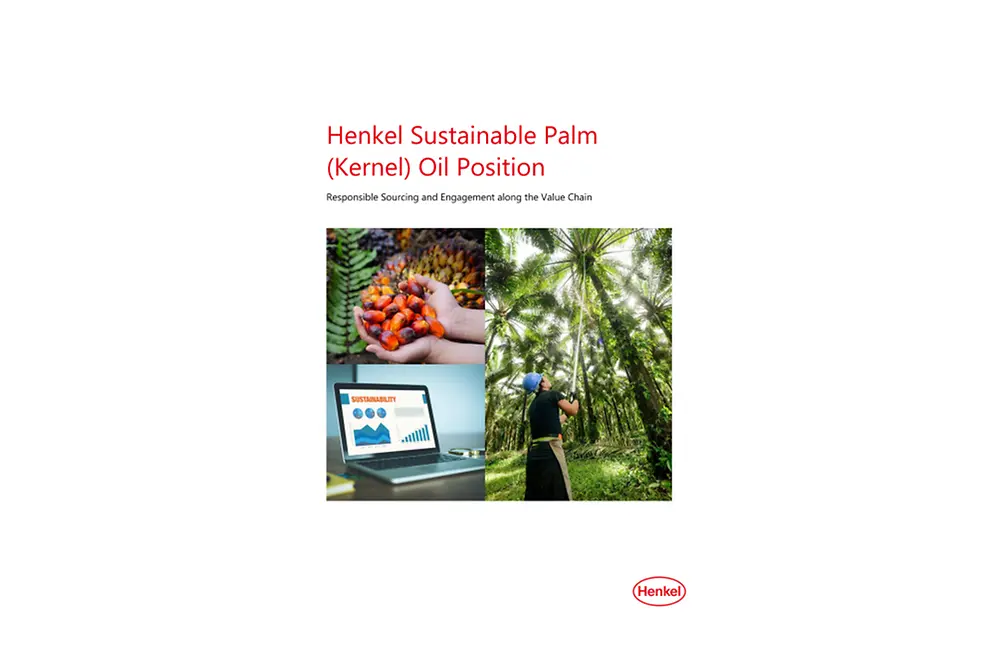
Henkel Sustainable Palm (Kernel) Oil Position

Responsible Sourcing and Engagement along the Value Chain. Explore our full Henkel Water Stewardship Position paper (EN).

Our Sustainability Ambition Framework

Our 2030+ Sustainability Ambition Framework sets the frame for our global sustainability strategy and covers the three dimensions of ESG: Environment, Social and Governance.