Annual Report 2025
incl. Sustainability Statement
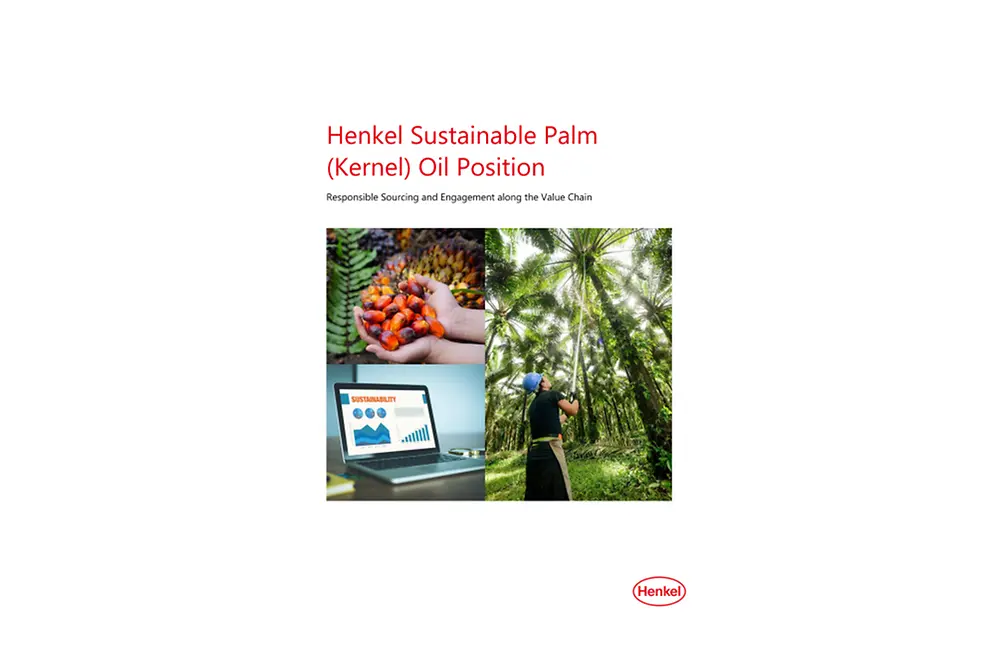
Sustainable Palm (Kernel) Oil
Henkel wants to drive progress toward sustainable palm oil and palm kernel oil – and make a positive impact on both the environment and the people affected.
At Henkel, we recognize our responsibilities regarding the purchase and use of ingredients based on renewable raw materials. This includes Palm (kernel) oil. Henkel sources ingredients based on palm and palm kernel oil for many of its products. Palm kernel oil, for example, is an important basis for industrially produced surfactants. For this reason, we are committed to ensuring that the ingredients for our products are made from sustainable palm oil and palm kernel oil. We work both with the companies from which we source our raw materials and with other partners such as smallholder farmers to exert influence on the palm oil supply chain. Henkel is committed to zero net deforestation and has an ambition of deforestation and conversion free sourcing of palm (kernel) oil. This deforestation free commitment and deforestation and conversion-free ambition for relevant commodities includes transparency along the value chain, no conversion of natural ecosystems to agriculture or other land uses, no burning or use of fire for land clearing/replanting, and a zero net deforestation or DCF (deforestation and conversion free) or NDPE (No Deforestation, No Peat and No Exploitation).
We use less than 0.2 percent of the palm oil and palm kernel oil produced worldwide. These derivatives are at the end of a long and often highly complex supply chain. For this reason, Henkel is committed to driving progress toward achieving sustainable practices across the palm oil industry and along the entire value chain.
We support both, the industry’s physical transformation and the market’s transformation to certified sustainable palm oil products. A multi-stakeholder approach is at the core of our initiative for sustainable management of palm oil and palm kernel oil. Through partnerships, projects and dialog, we engage with key players, and we are expanding our contribution to sustainable practices in the palm oil industry.
Henkel is a committed founding member of the Forum for Sustainable Palm Oil (FONAP) in Germany and is a member of various working groups dedicated to palm (kernel) oil sustainable sourcing. Through these engagements with other companies, NGOs, associations and political bodies we advocate for finding ways to increase the proportion of sustainably produced palm (kernel) oil and improving existing standards and certifications.
Henkel, along with other leading consumer goods manufacturers and companies in the oleochemical industry, is also a founding member of the cross-industry Action for Sustainable Derivatives (ASD) initiative. The primary objective of the initiative is to generate more transparency in the complex value chain for palm derivatives. Activities include assessing identified risks, promotion of the sustainable production and procurement of palm (kernel) oil derivatives and sharing best practices and solutions that can comprehensively transform the complex palm oil derivatives sector. To that end, Henkel also supports the efforts by ASD to develop an enhanced monitoring approach for the proactive detection and tracking of abuses and non-compliance with zero net deforestation requirements. Additionally, we collaborate in the harmonization of requirements, tools and criteria to create fair conditions for competition among companies who produce ingredients and with their direct suppliers. In the framework of our partnership, ASD achieved collective transparency for 1.13 million tons of palm (kernel) oil-based materials in 2023. This represents around 1.3 percent of the global palm (kernel) oil production,15 percent in terms of volume of the global palm oil-based oleochemicals market and 31 percent of the palm kernel oil-based oleochemicals market.
We are also actively involved in the Roundtable on Sustainable Palm Oil (RSPO). The RSPO standard includes compliance with human rights along the entire supply chain, in addition to addressing environmental issues. In 2023, our Global Supply Chain organization was again successfully certified until 2029 in line with the RSPO’s supply chain certification standard. To uphold these standard yearly audits will be conducted.
We have partnered with the civil society organization Solidaridad on initiatives in Ghana, Honduras, Indonesia, Colombia, Mexico, Nicaragua and Nigeria since 2013. Our projects’ focus is on improving palm (kernel) oil smallholders’ livelihoods, incomes and resilience, simultaneously making a positive contribution to the environment and climate. In 2025, we are engaged in projects in Colombia and Honduras. Building on the very good collaboration with Solidaridad, we have developed specific plans for the next few years to expand the commitment further.
Building on our 2020 objectives, we have set more far-reaching targets for 2025 that we believe will address the key priorities for successfully transforming the palm oil industry. These targets are focused on the specific challenges where we can make our strongest contribution. The targets for 2025 are:
1 The survey was conducted in 2024 based on the supplier data for 2023.
We are committed to full transparency and traceability of our palm (kernel) oil supply chain and work in collaboration with our suppliers and industry peers toward this aim. In addition to the related collaboration efforts and progress to the target detailed above, here we publish our list of mills potentially connected to our top 90 percent volumes of palm (kernel) oil-based derivatives supply chain and our list of key palm (kernel) oil suppliers.
⠀