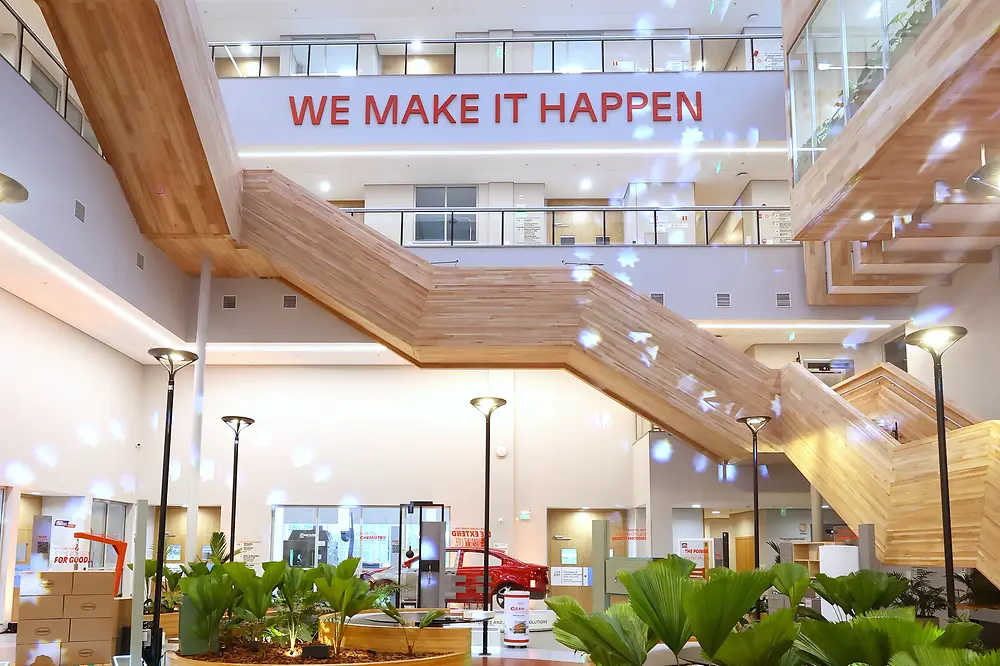
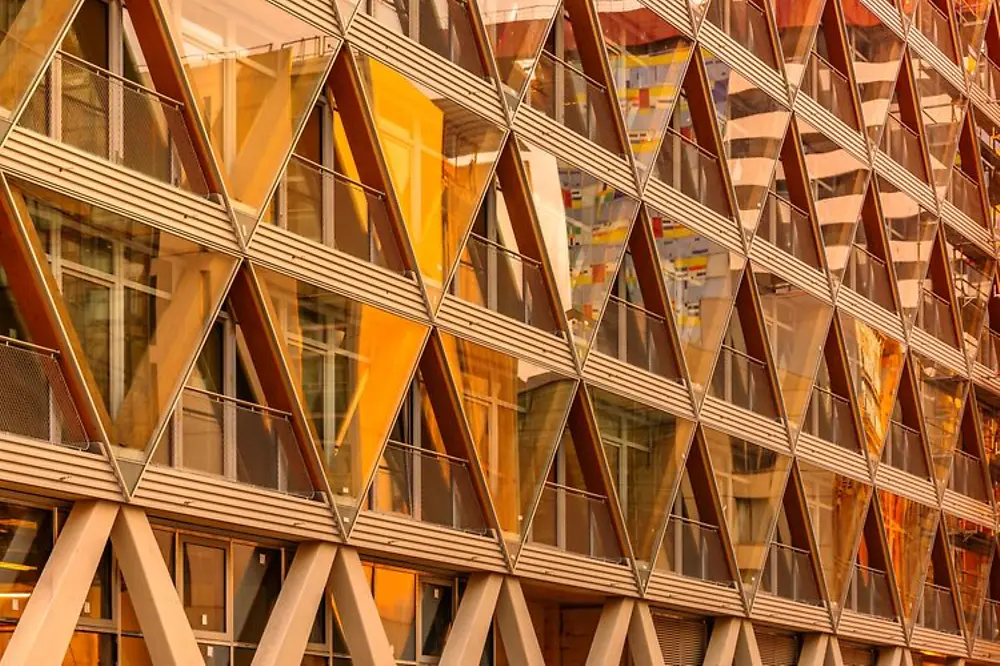
Concrete jungle. Grey. Too cold in winter. Too hot in summer. Many cities still feel that way. In the Medienhafen district of Düsseldorf, there is a building that speaks a different language: The Cradle is an office building with a striking façade of timber diamond shapes, where wood is not just decoration but structure. Framework. And right at its heart, invisible yet indispensable: adhesive – “the unsung hero,” as Marcel Blodau calls it.
Story
Structural adhesives, the unsung heroes of timber construction
Wood is widely regarded as the building material of the future. But turning renewable raw materials into high-rises that can genuinely bear structural loads takes more than good timber. It takes adhesives that deliver on what architecture promises. This is where Henkel Adhesive Technologies comes in: driving mass timber construction forward with innovative solutions.
In this story, you will learn:
> How Henkel contributes to modern timber construction
> What distinguishes timber construction from conventional concrete building methods
> The key advantages of building with timber
> How adhesive technologies help make timber structures more fire-resistant
> The role used cooking oil plays in sustainable timber construction
> How Henkel collaborates with and supports its partners
> Where timber buildings are shaping cities around the world
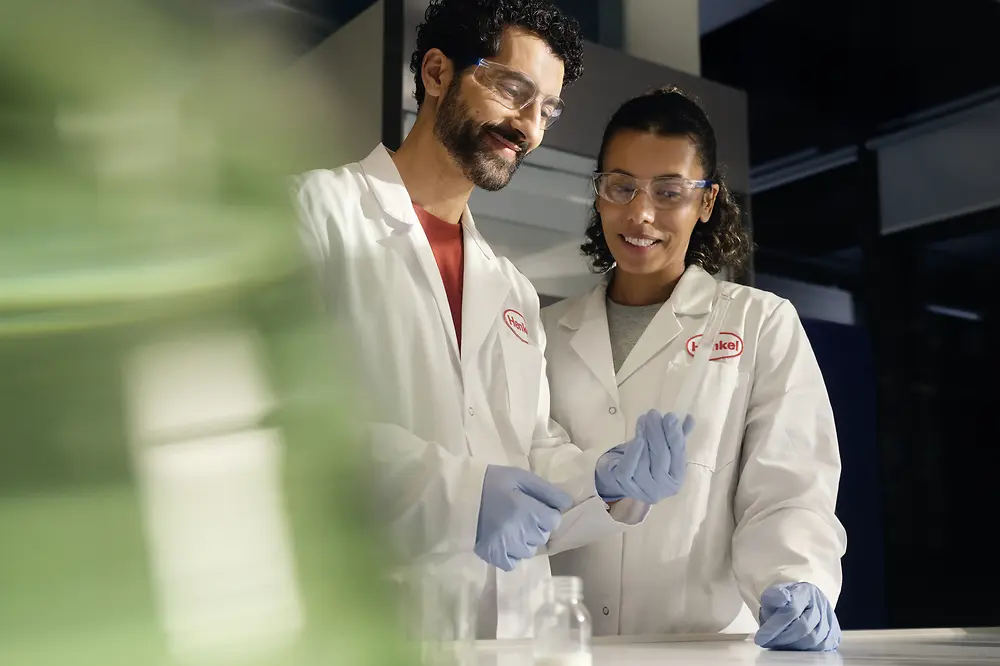
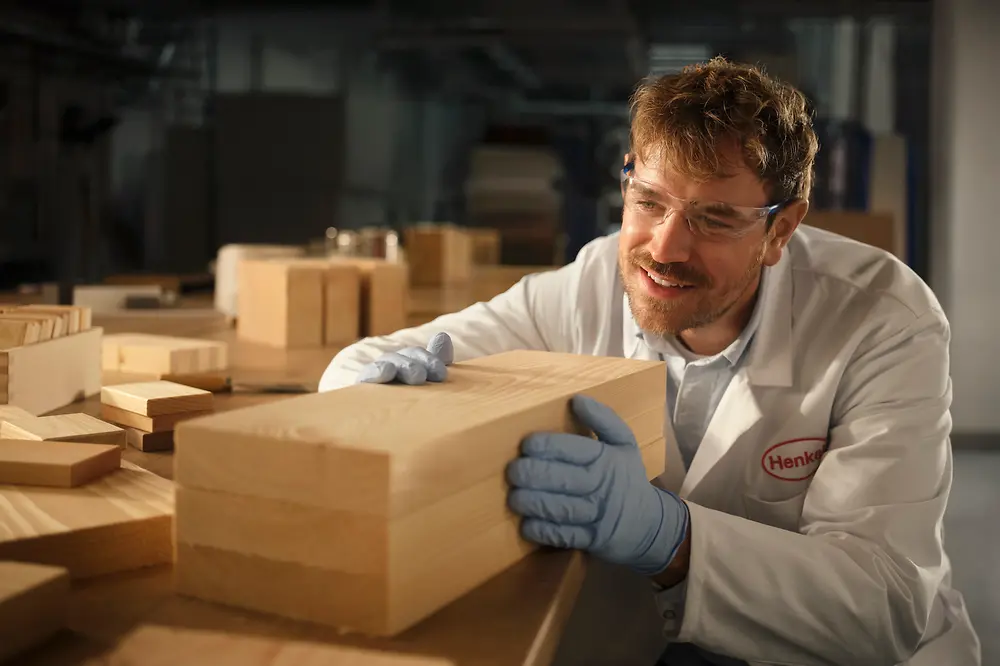
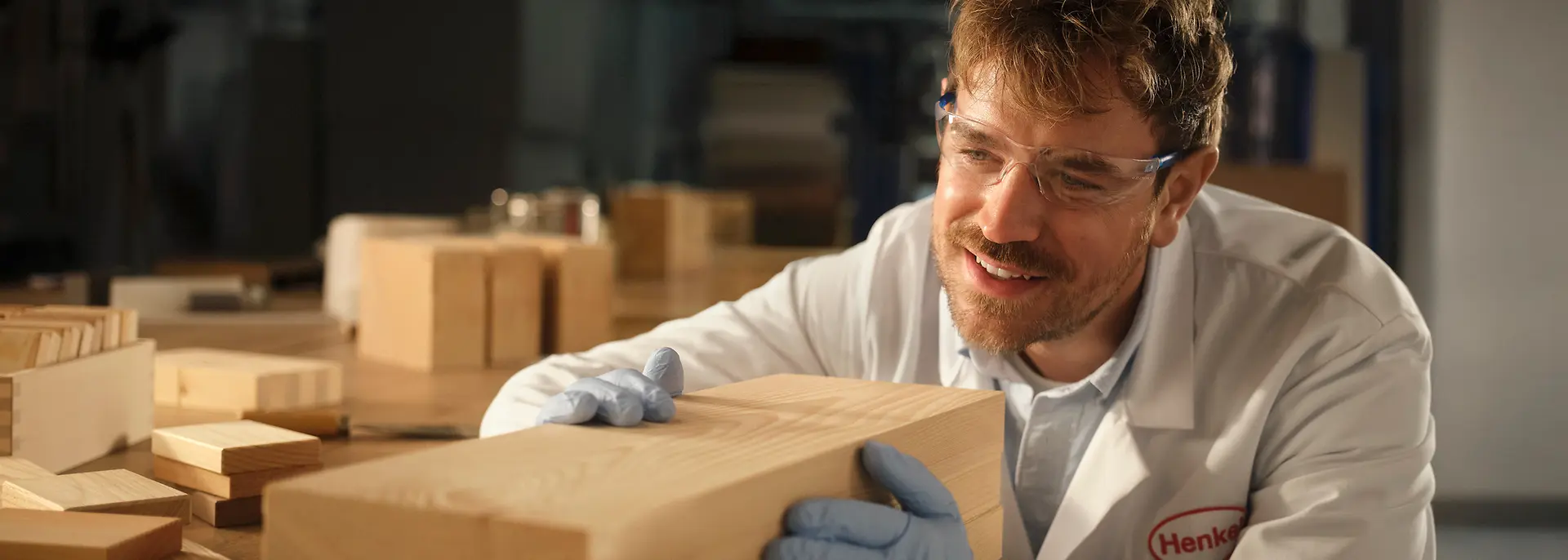
Marcel works in product development at Henkel Adhesive Technologies, focusing on Engineered Wood, structural timber construction. “We’re not talking about chairs or tables. We’re talking about structures that carry loads: walls, ceilings, high-rises,” says Marcel, explaining why the right adhesive is so critical: in cross laminated timber (CLT), layers of wood are stacked at 90-degree angles and bonded with adhesive. Cross-bonded layers compensate for the natural weak points of timber and achieve strengths comparable to concrete and steel. “That is only possible through the combination of adhesive and wood,“ explains Marcel.
Marcel has been part of the team since 2020. While the market has long been dominated by melamine-urea-formaldehyde (MUF) adhesives, Henkel focuses on polyurethane, a technology that contains no water and no solvents and can be processed at room temperature. “Polyurethane in structural timber construction is a comparatively young technology. We are at the beginning of a shift from concrete to more sustainable wood as building material – and that is exactly what makes it so exciting.”
BUILDING TOMORROW.
FROM WOOD TO SMARTER LIVING.
FROM WOOD TO SMARTER LIVING.

A different way of building
What sets timber construction apart from steel and concrete is not just the material itself. It is the way buildings can be constructed. Timber components are manufactured in climate-controlled facilities, year-round, regardless of weather. When concrete cannot cure in winter, a conventional construction site comes to a standstill. In mass timber construction, production continues. “A finished wall element arrives on site and just needs the door fitted,” explains Marcel. That means shorter, more reliable build times and fewer trucks on the road.
Years of research, leaner processes
Claudia Meckel, who leads global product development for structural timber construction at Henkel, sees a further advantage: “Construction teams can prefabricate in a heated factory instead of standing on a building site in freezing temperatures. That is better for the workforce, for build quality and for planning reliability alike.”
When Claudia talks about her work, one thing quickly becomes clear: for her, this is more than a job. The chemist with a doctorate joined Henkel in 1998 and began building the structural timber construction team in 2020. There is a personal dimension to it as well: the prepolymer on which Henkel’s timber adhesives are based – the chemical building block that gives the adhesive its bonding properties – was developed by her father, a chemist who spent many years in fundamental research. “It is wonderful to see what has come out of so much research and development work,” she says.
Henkel’s ambition does not stop at the laboratory. The assembly time/press time ratio – the relationship between how long an adhesive remains workable and how long it needs under pressure to cure – shows how far product development reaches: directly into customers’ production processes. “If the adhesive has a long open time but a short press time, that increases the output of the entire production line,” explains Claudia.

We are at the beginning of a shift from concrete to more sustainable wood as building material – and that is exactly what makes it so exciting.
Marcel Blodau, Product Development Manager Engineered Wood Western Europe at Henkel
Timber burns. Or does it?
There is one question that comes to mind immediately: Don’t timber buildings burn far more quickly? Claudia shakes her head. Steel softens under extreme heat and loses its structural integrity. Timber, by contrast, chars on the outside, forming a protective layer while retaining its load-bearing capacity in the core for a long time. For tall buildings, adhesives are needed that actively support this behavior. In a fire, an adhesive must not melt. If it does, the char layer falls away, fresh wood is exposed and the fire gains strength again. “Using phosphorus compounds, the adhesive forms a stable char layer,” explains Claudia. “This allows timber structures to remain stable, enables safe evacuation and is a key enabler for high rise timber construction.”
Henkel’s position as a pioneer in this field is clear from the fact that its internal research division began working on the topic as early as 2017 and long before EUROCODE 5: The European standard that for the first time sets binding fire protection requirements for adhesives in structural timber construction. “The goal was clear: develop adhesives that make it possible to build tall buildings from wood,” says Marcel. Henkel is the only supplier worldwide offering a fire-retardant polyurethane adhesive, LOCTITE HB X, that meets both European and American certification standards. Building on this success, Henkel introduced the new fire-retardant LOCTITE HB XE product line in 2025. The new generation adhesive delivers outstanding performance in meeting the latest EUROCODE 5 requirements while also offering enhanced processing and application properties for customers.
Advancing sustainability beyond the wood
Sustainability in timber construction operates on several levels: CO₂, recycling, health, certification. The visible dimension: Wood stores CO₂ and replaces energy-intensive concrete. The less obvious one: the bonding agents themselves. But Henkel goes a step further. The answer is mass balance – a certified accounting method that tracks the share of sustainable raw materials through the production chain – and it starts with used cooking oil. Used cooking oil is processed into bio-naphtha which is fed together with conventional naphtha, into the start of the chemical production chain. Through a certified mass-balance accounting system, the improved CO₂ footprint can be documented and passed along the entire supply chain as a certificate. The result: the LOCTITE HB S ECO line – the first polyurethane adhesive for structural timber construction certified under ISCC Plus, an internationally recognized sustainability standard. “With this, we can reduce the CO₂ footprint per kilogram of adhesive by up to 60 per cent,” says Claudia. Marcel adds: “We are currently the only supplier in the polyurethane space with this certification.”

Construction teams can prefabricate in a heated factory instead of standing on a building site in freezing temperatures. That is better for the workforce, for build quality and for planning reliability alike.
Claudia Meckel, Senior Manager Global Product Development Engineered Wood at Henkel
A partnership that holds
Jeanine Wojciechowski has been responsible for Henkel’s European business in structural timber construction since September 2025. And is still captivated by what she sees every day. “Every time I walk into the production facility, it is fascinating to see what comes out of the lamellas,” says the South African-born sales leader. “That our adhesive is strong enough to enable load-bearing structures – that is, honestly, remarkable.”
Customers are timber mills and timber construction companies. Businesses that often grew from small sawmills and developed over generations into manufacturers of structural mass timber elements for multi-story construction. Family-owned, deeply knowledgeable, and demanding to match. They ask about products for new wood species and new applications. This constant appetite for innovation is what draws Jeanine to the industry: “Our customers don’t ask what we want to sell them. They ask what we are bringing next.”
Henkel is more than a supplier, it is an active partner. When something goes wrong on a customer’s production line, Henkel’s application engineering team steps in, sometimes for several weeks. “The problem isn’t always the adhesive,” says Jeanine. “We had a case in Europe where adjustments in the machine were required, not the adhesive. We could have left the customer to tackle this issue on their own. However, we consider ourselves more than just an adhesive supplier and place great value on our long-term partnerships. That is why our sales and application engineers worked closely with the customer to resolve the issue together.” That is what shapes the close customer relationship, she says: “Customers know that Henkel does not leave them to figure it out alone.”
At the heart of this customer partnership is the Center of Excellence located in Sempach, Switzerland. The reasoning is practical: in a running production environment, you cannot simply experiment for weeks, every interruption has a cost. That is why Henkel operates a dedicated facility of 400 square meters where seven pieces of industrial equipment run at semi-industrial scale and replicate customers’ production conditions. Here, the team supports customers with prototyping, certification, training and application trials, for example – testing new wood species and resolving processing issues without a single shift being lost at the customer’s site. “The Center of Excellence produces solutions you would never find at a desk,” says Jeanine.

Our customers don’t ask what we want to sell them. They ask what we are bringing next.
Jeanine Wojciechowski, Head of Sales Engineered Wood Europe at Henkel
Projects that show what is possible
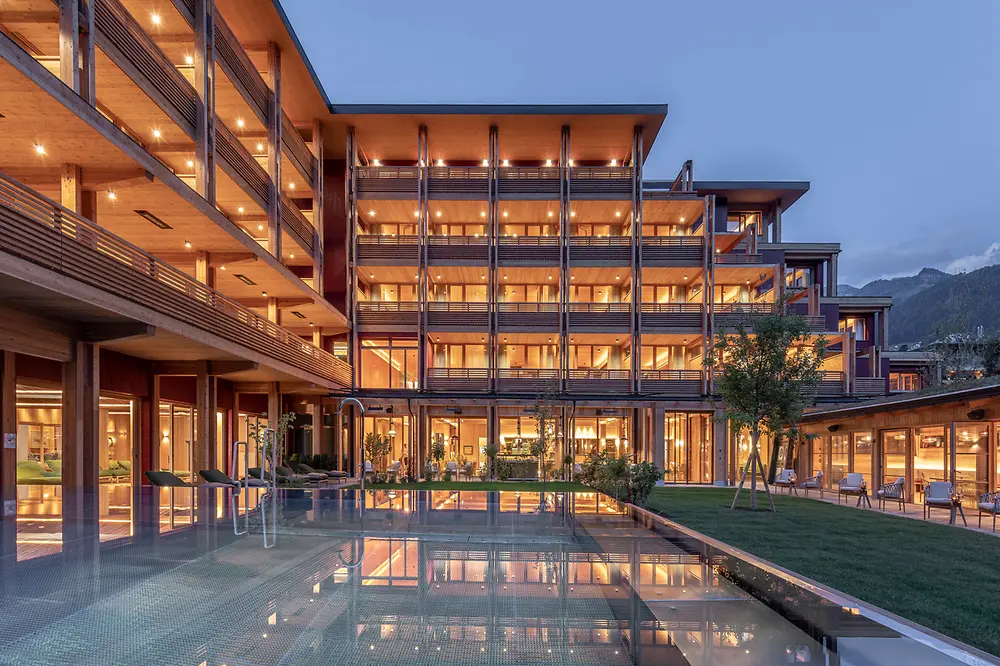
The Cradle in Düsseldorf is a case in point. Built according to the Cradle-to-Cradle principle – hence the name. With a significantly lower CO₂ footprint than a comparable conventional new build. “It is gratifying when projects like this emerge on our doorstep,” says Marcel. “But it is happening all over the world now – from timber high-rises in Australia to the recently opened Inspiration Center built by Henkel in Brazil.” Jeanine puts it simply: “This team doesn’t just do the work. It leaves something behind.”
Concrete jungle. Perhaps one day that will belong to the past – thanks to timber, adhesives and a great deal of innovation.